
Dad’s Story
2,000 miles across Europe
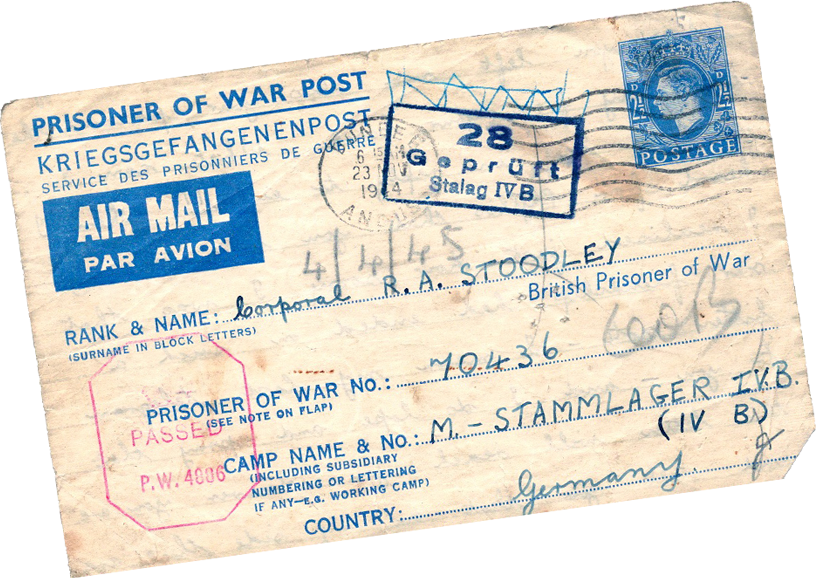
Lance Corporal ROBERT ‘BOB’ STOODLEY
22nd Independent Parachute Company – The Pathfinders
First in.
At around 00:17 on 6th June 1944 Bob Stoodley was in the very first aircraft to ‘drop’ on D-Day aged just 20 – First In.
At around 22.55 on 28th August 2021, the sole remaining D-Day Pathfinder slipped quietly away aged 97 – Last Out.
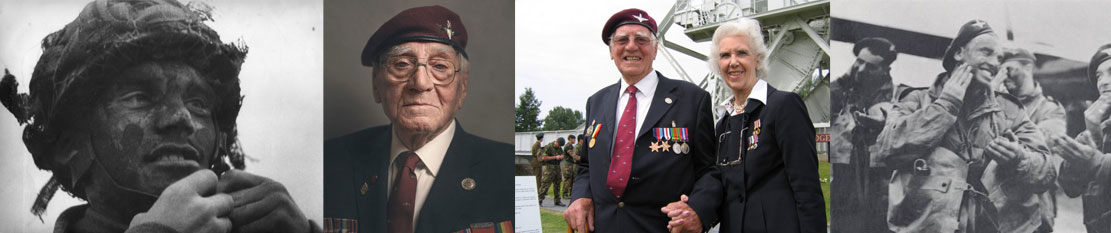
Lance Corporal Robert ‘Bob’ Stoodley volunteered to join the 22nd Independent Parachute Company – The Pathfinders – from the Black Watch and was under the command of Lieutenant Bob Midwood.
There were 4 sticks of 10 men deployed before the main assault to check the DZ for enemy presence, set up and operate Eureka Beacons to guide in the Paratroopers and Gliders.
Midwood’s stick was to land on DZ-K and link their Eurekas with the ‘Rebeccas’ of the 8thPara Battalion flying in, whose mission was to destroy several bridges on the River Dives, east of Caen to protect this flank for the beach landings.
Jumping at No 5 around 00:17 at 600 ft in darkness over DZ-K near Touffreville, the stick got dispersed but Bob alongside Sergeant Boardman, Pte. Ken Norton and Lce Cpl Hackman, was able to successfully deploy his Eureka Beacon.
Sadly his good friend and body guard, No 6 – ‘Paddy’ O’Sullivan – was killed in action almost as soon as he landed with legend being he was found by local villagers opposite a dead enemy soldier.
Once the main body of Paratroopers left to carry out their destructive tasks, the alerted enemy moved in force into the area with Tanks and Bob was ordered by Sgt Boardman to destroy his Eureka to prevent it being compromised.
This action however was always going to give away his position and Bob was mortared in the shallow trench he was hiding in.
He was injured, burnt, knocked senseless and then captured, being tied to the camouflage netting on an enemy armoured vehicle which took him away. At this point there was a fire fight and the tank came under fire from the remaining Paras, totally unaware Bob was strapped to the back. Such was the fire, he was actually hit in the leg, but the tank commander, did a 180 and reversed away to protect him from fire so they could interrogate him.
Bob believed that this action probably saved his life.
After being taken to a German field hospital, to dress his wounds, he was then taken in the back of a lorry to a Chateau and interrogated by the Feldgendarmerie (SS Field Police) and after refusing to submit any information other than Name, Rank and Number he was taken to Rennes Hospital then to Rennes POW camp.
Around the end of July, he was loaded on a train with approx. 650 other POWs in crammed conditions with about 40 or 50 others in a ‘Box Car’ livestock carriage, destination Stalag IVB.
This arduous journey Bob recalls was mainly executed at night to protect the train in the darkness from the allied fighter planes, but on several occasions the train was ‘straffed’ by the allies thinking it was a supply train, unfortunately with some fatal consequences.
Although only a Lance Corporal, Bob was already a natural leader and took it on himself over the approx. 23 day journey to ensure each of the POWs in his carriage received their fair and exact share of German ‘black bread’ and water. These carriages had nothing but straw on the floor and one bucket in the corner, and if you stood up to reach up to the high barred window lights, you often lost your place on the floor.
One instance when they were stopped, he even turned a rail-side grinding stone wheel to flick up the dirty water and the grateful and thirsty POWs got sore tongues from licking the stone wheel.
There were unsuccessful attempts to escape from the carriage, including cutting the side panels that then became hidden from the guards on the outside when the sliding doors were opened at stops.
With the train often having to retrace its route due to bridges and the track ahead being destroyed, and stops at Trier and even Colditz for one night, the train eventually arrived at Neuburxdorf where they were unloaded for the POW Camp at Stalag IVB which would be his home with 30,000 other POWS until May 1945.
During his stay, as he was an engineer, Bob would rig up lighting from the main camp electricity feed cables and supply the makeshift Drama shows with lighting, and he also invented his own form of ‘kettle’ which was basically a live ‘element’ fixed across two mains wires and hung in a metal tin container.
Bob recalled a POW coming in and saying ‘ tea’ and as he touched the container there was a bang before he left direct to the medical centre.
Bob joked he never saw him again and thinks his ‘kettle’ was a major source of allied casualties.
He remained under medical care in Hut 60B till he ‘escaped’ with Paul Newton after the camp was liberated by the Russian Army in 1945 and control was much more relaxed.
Stealing a motorbike with a trailer, he and Paul who eventually became his Best Man, managed to survive for several days killing piglets and chickens and trying to find their way to freedom.
A frightening recollection by Bob, and one where he feared most for his life, was stumbling across a group of now friendly Russian soldiers, Who invited him and Paul to drink with them.
As there was a shortage of alcohol, the Russians would mix their limited Wine supplies with Petrol. After sipping and spitting out this vile mix, the Russian soldier simply commanded ‘DRINK’ and pointed his revolver at Bob’s head …. Apparently he never drank so fast in his life !
After helping some political prisoners to safety from Brückenkopf Wehrmacht Prison he and Paul eventually managed to cross the expanse of the River Elbe spanning the destroyed structure from the Russian side, to the amusement and encouragement of, and to the safety of the American allied forces where he was de-briefed, treated and returned to the UK.
When Bob left Service, he married his beloved Joyce in 1950, but the family was not without loss with Joyce’s two older brothers killed during the conflict, Douglas at Dunkirk and Clifford lost on HMS Airedale.
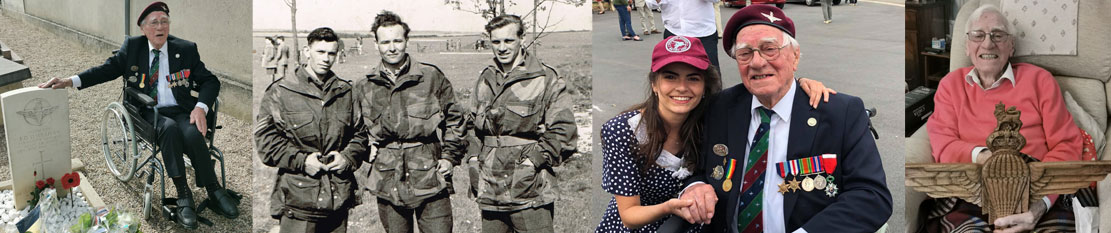
He then turned his attention turned to business but keeping in touch with many comrades of his stick, especially Captain Bob Midwood with whom he became great friends.
Probably because of his childhood and the fact his father was a fantastic mechanic, his success was in the Motor trade,
From this point Bob returned to Normandy almost every D-Day anniversary and always attended the single military grave in Touffreville Church of Edward Delany ’Paddy’ O’Sullivan, his great friend.
The fantastic story here is the villagers of Touffreville, after finding Paddy fatally wounded, adopted him as not only their single liberator, but the liberator of all of France, and that is why Paddy O’Sullivan lays rest in a single Military War Grave in their village, and each year there is a public ceremony and remembrance simply for Paddy.
Bob always had a thirst for adventure too and was on both the 1972 and 1975 Everest South West Face Expeditions with Chris Bonington as well as the International Karakoram Project.
For the 1975 Everest Expedition, with 4 other drivers, he organised and drove two overladen Ford D Series trucks 7200 miles from London to Kathmandu in just 24 days, around the clock through dangerous bandit ridden terrain and mechanicing the lorries himself to ensure they safely reached their destination.
Chris Bonington’s words were “they could have replaced any of the top Climbers with another and made it to the summit in 1975, but I doubt that anyone else could have succeeded in the task of delivering the expeditions’ vital equipment on such a hazardous journey by road”
He was one of 14 children, and another great story was of his younger brother Jim, just 14 years old, who actually stole a plane from the American Air Base on Salisbury Plain with his younger 12 year old in the other seat to go and ‘find’ Hitler, but crash landed it in treetops (see Jim Stoodley’s Private War) before he got ‘a stiff talking to’ !
None of his children are in the forces, but his only daughter ‘Weed’ took to the canopy aged 40 and is now a multiple World ‘sky-diving’ Champion.
Bob lost his beloved wife Joyce in 2015 and he would visit her grave every day without fail until a down turn in Bob’s health affected his mobility.
He lived his last few years in constant pain, but never did his love for Joyce, nor his pride of being a member of the Pathfinders wain.
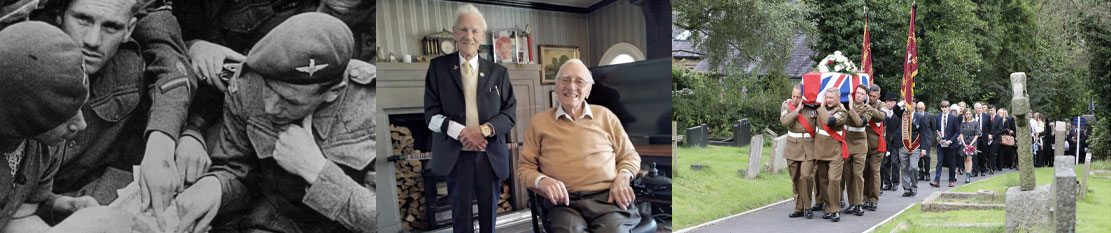
Bob was buried alongside Joyce in St James’ Church, Buxworth with attendance from 4 PARA, the PRA and active members of The Pathfinders.
Always a true gentleman, a man of his word.
‘Over and Out’
Lance Cpl. Robert ‘Bob’ Stoodley
1924 – 2021
22nd Independent Parachute Company
Every Man an Emperor.
DONATE TO SUPPORT OUR PARAS

DONATE TO ST JAMES CHURCH
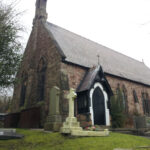
If you would rather donate to St James’ Church where Mum and Dad are both laid to rest, a Church that Dad has always supported please donate here.